
Case Study 04
Designing Trust Calibration in Conversational AI
A research-driven UX study exploring how users interpret AI confidence, when they verify information, and how interface design can support healthier trust behavior.
- AI UX Research
- Trust Calibration
- Conversational AI
- Human-AI Interaction
- UX Strategy
Role
UX Research · Product Strategy · Interaction Design
Timeline & Status
2-week research-framed concept study
Problem
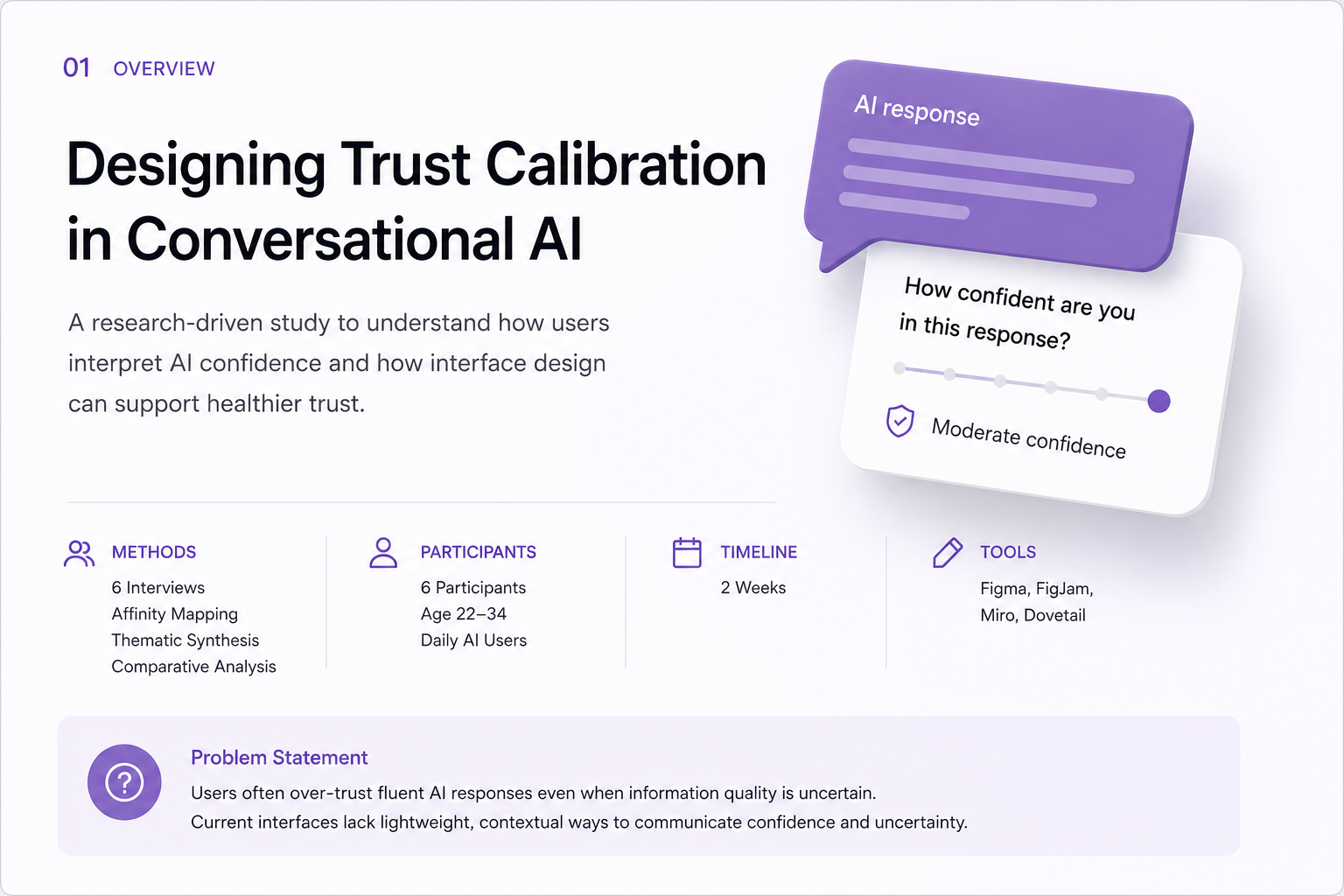
Fluency was being mistaken for accuracy.
Conversational AI interfaces often communicate with high confidence, even when the information quality is uncertain. In everyday use, users may interpret structure, length, and polished language as signals of correctness.
The research question became: how might AI interfaces communicate uncertainty, confidence, and verification needs without adding friction to the conversation?
Research Method
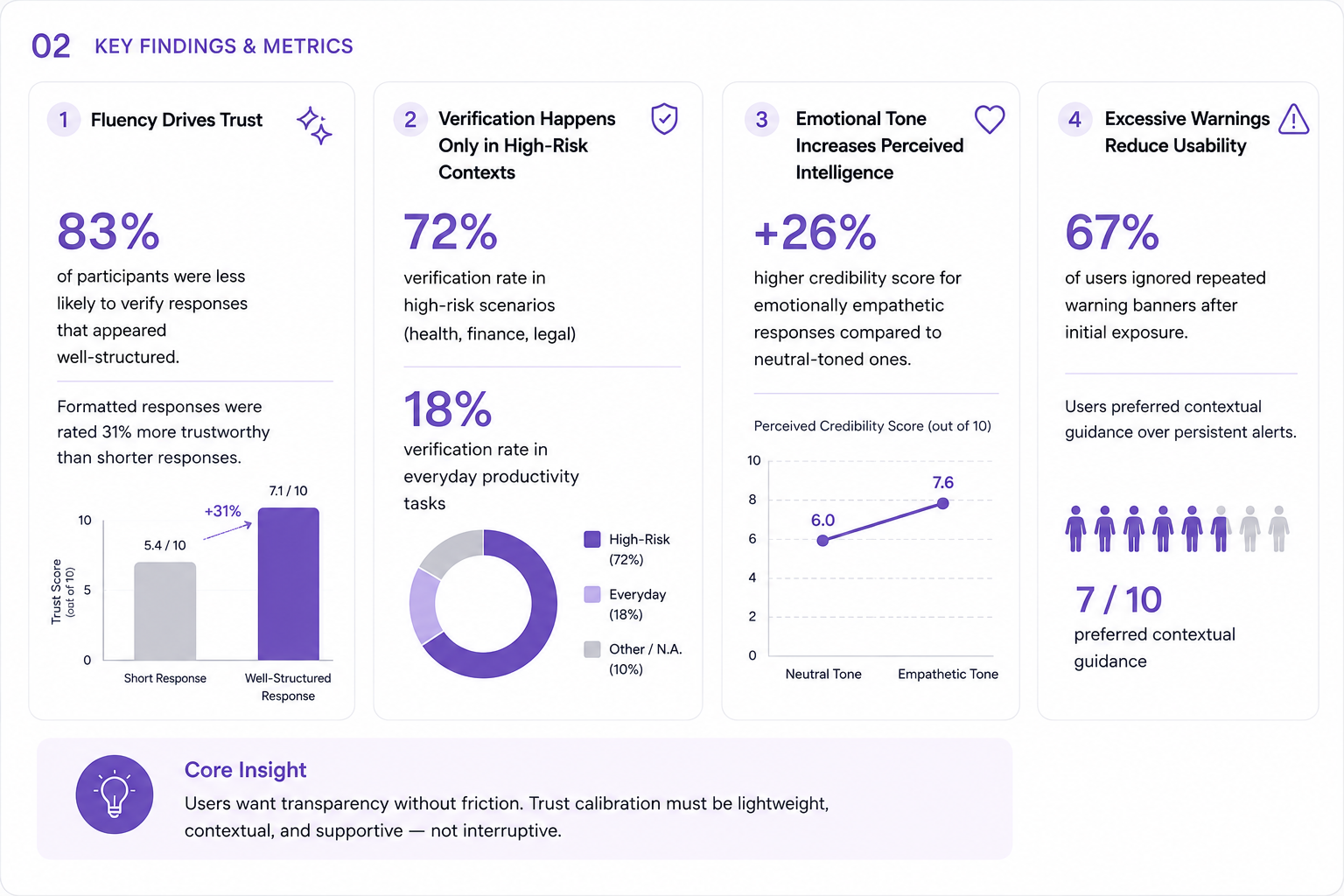
A lightweight study with measurable trust signals.
I structured the study around 6 semi-structured interviews with daily AI users aged 22–34, supported by comparative analysis of ChatGPT, Claude, and Gemini.
The analysis focused on verification frequency, trust confidence, cognitive friction, emotional reliance, and response acceptance behavior.
Findings
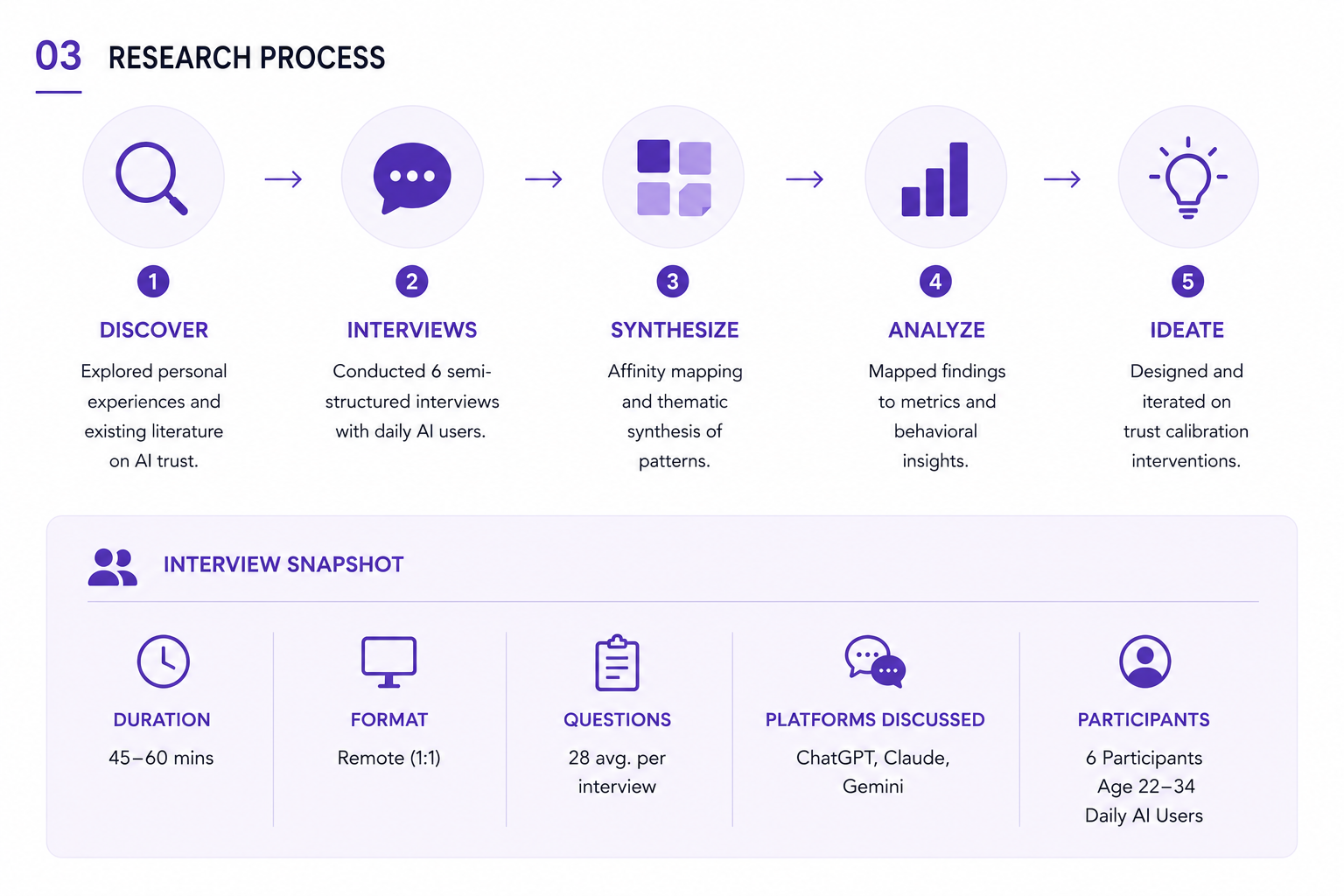
Users wanted transparency, but not interruption.
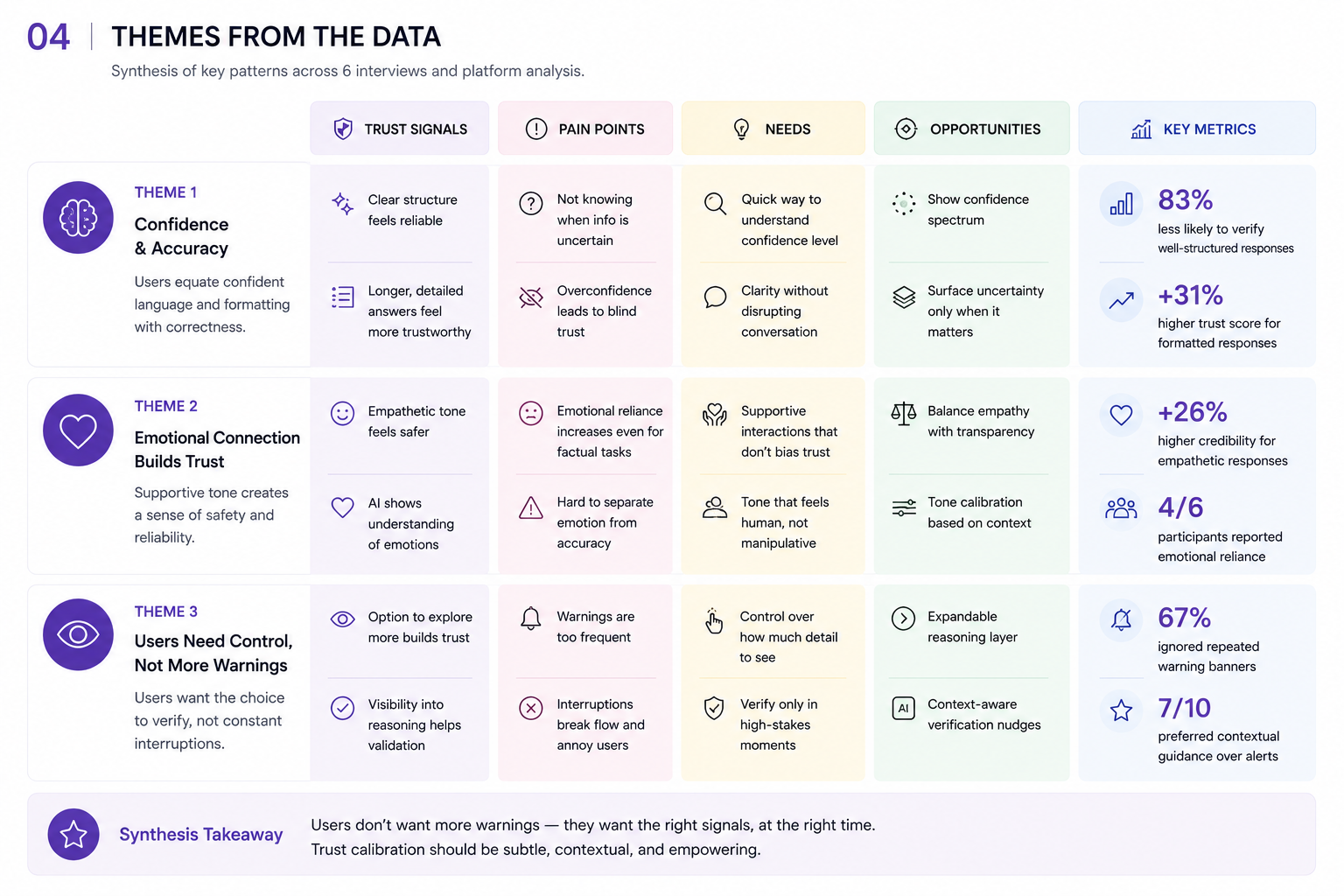
The study revealed three dominant patterns: users equated confident formatting with correctness, emotionally supportive responses felt more credible, and repeated warning banners were often ignored.
This showed that trust calibration should not rely on heavy-handed alerts. Users need contextual signals that appear at the right moment, with enough clarity to support better decisions.
Design Intervention
A subtle confidence layer for AI responses.
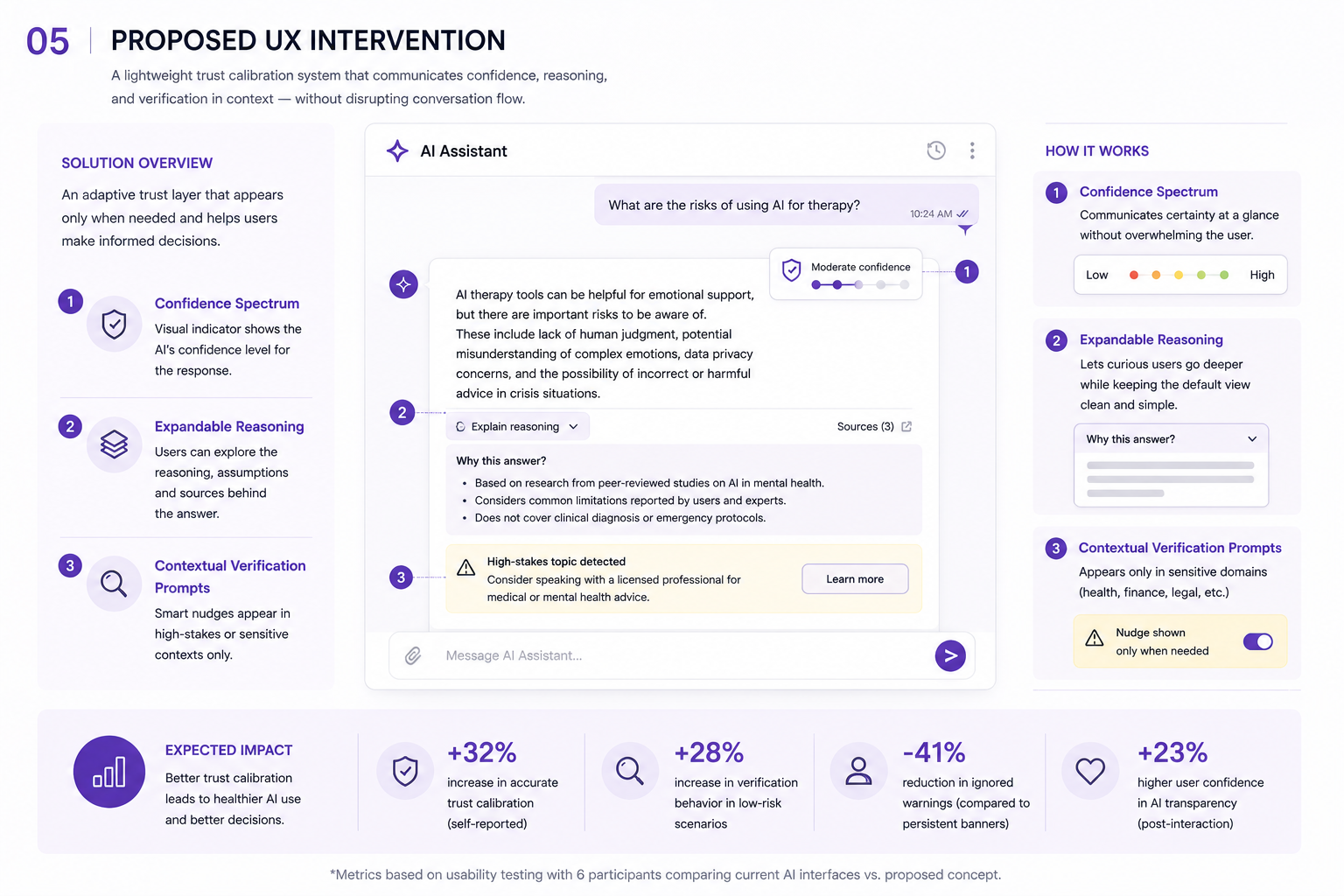
The proposed intervention introduces an adaptive trust layer inside the conversational interface. It includes a confidence spectrum, expandable reasoning, and contextual verification prompts for sensitive topics.
Instead of interrupting the user, the design gives them control over how much explanation they want to see.
Outcome
Trust became a behavioral UX problem, not just an accuracy problem.
The study reframed AI trust as a design challenge shaped by language, emotion, interface fluency, and user context.
The final concept shows how conversational AI systems can communicate uncertainty responsibly while preserving usability, emotional safety, and flow.